PET Care Words in English for Kids
Pet care vocabulary covers nouns, verbs, and phrases for feeding, cleaning, playing with, and protecting an animal. Pet Care Words in English for Kids: Vocabulary and Activities teaches practical language through daily routines such as filling a water dish. Begin with familiar pets. Objects, actions, and pictures strengthen recall. No pet is required: use toys, drawings, role-play, or animal photos.
📥 PET Care Words Practice Pack
Read, match, choose, and build useful sentences about caring for pets.
Leave your email — we'll send the PDF to your inbox.No spam — the PDF plus one short reminder. Unsubscribe anytime.
Essential Words and Phrases
Pet Care Words in English for Kids: Vocabulary and Activities starts with visible items and actions children can copy. Pair nouns with verbs: a dish with fill the dish, or a brush with brush the fur.
The table groups language by routine. Choose four to six rows, then add more after your child uses the earlier phrases without prompts.
Pet terms vary across countries. British English often uses lead and litter tray; American English often uses leash and litter box. Both forms are correct. Teach the form your child hears most often, then introduce the alternative.
PET Care Language in Context
Pet Care Words in English for Kids: Vocabulary and Activities supports short messages: “The dish is empty,” “Please fill it,” or “The cat is drinking water.” One object can express several meanings.
Build short exchanges with questions: “What does the rabbit need?” “It needs food.” “Where does the fish live?” “It lives in a tank.” “How do we care for the dog?” “We give it water, brush its fur, and take it for a walk.” Accept one-word answers, then model full sentences.
Older children can explain a routine in order: “First, I check the water. Next, I refill the dish. Then, I clean the pet’s space.” Words such as first, next, then, and finally connect vocabulary into speech.
How to Introduce New PET Care Words
Begin with one animal and one care task. Show a toy dog and a water dish, then say, “The dog needs water. Fill it.” Let your child point, act, and repeat. Teach meaning before spelling.
Next, change one sentence part. Replace dog with cat, or water with food. Children notice which words stay fixed and which can change. A home language can support understanding before the child returns to English.
Practise recall, not only rereading. Hide the brush and ask, “What is missing?” Pause during a pretend routine and ask, “What comes next?” If needed, offer two choices. Aim for successful use without creating worry.
Activities for Different Ages
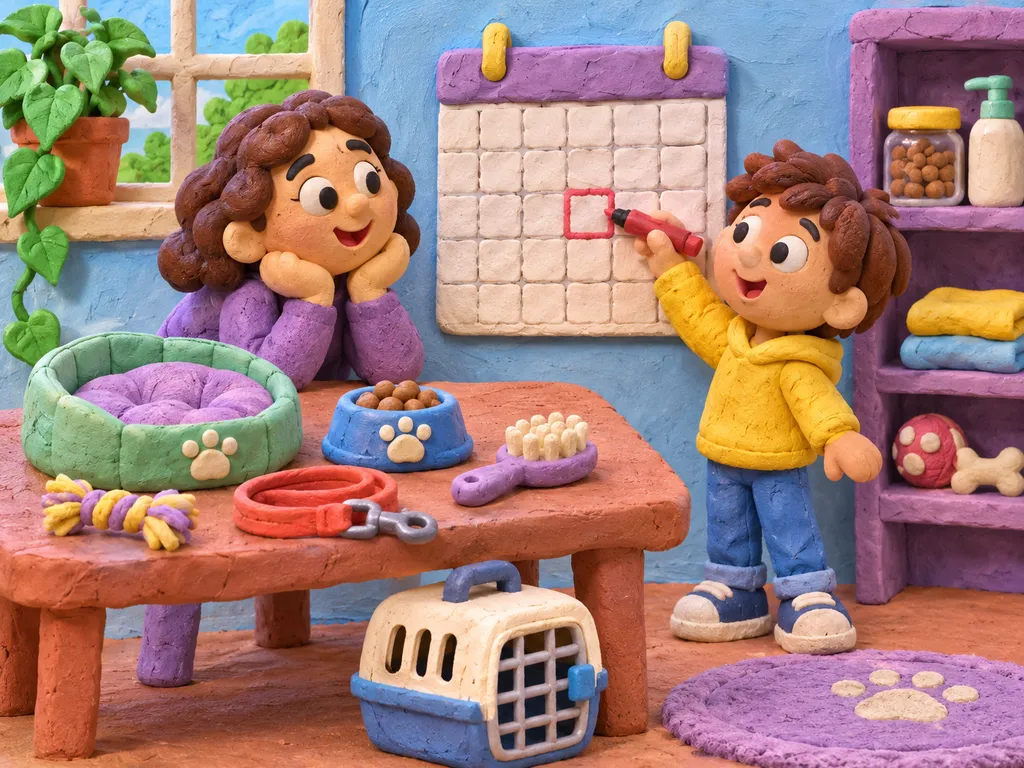
For school-age kids, use toys and movement. Place a toy pet, feeding dish, bed, and brush on the floor. Give one-step instructions such as “Brush the pet” or “Put the pet in bed.” Keep rounds short and repeat phrases through play.
For school-age kids, make routine cards with a picture on one side and a phrase on the other. Your child can sort them into food, cleaning, play, and health, then say a sentence for each card. Pet Care Words in English for Kids: Vocabulary and Activities can become a guessing game: “You use this to groom fur. What is it?”
Build a Care Routine
Choose a pet and say four steps in order. Use this frame: “First, I ____. Next, I ____. Then, I ____. Finally, I ____.” Change one step and ask your child to spot the difference.
For school-age kids, use problem-solving tasks. Ask your child to plan an animal’s daily routine, compare two pets, or pack for a vet visit. An adult must handle medicine and tasks affecting animal safety.
Practice Routines and Common Mistakes
Use Pet Care Words in English for Kids: Vocabulary and Activities as a weekly plan, not one long lesson. On day one, name objects. On day two, add actions. On day three, ask questions. Later, use role-play or a spoken care plan. Five focused minutes can cover one review.
Distinguish nouns from verbs. Food is a noun, while feed is a verb: “The food is in the bowl,” but “I feed the cat.” A walk can be a noun or verb: “We go for a walk” and “We walk the dog.” Teach both patterns.
Do not mark regional forms as mistakes. Lead and leash name the same item; litter tray and litter box serve the same purpose. Correct one point at a time. Restate the child’s idea in a complete sentence, then invite another attempt without stopping the conversation.
- Choose five pet care words and match each to a picture.
- Say each word aloud, then use it in one simple sentence.
- Sort vocabulary cards into food, grooming, exercise, and shelter groups.
- Act out feeding, brushing, and walking while naming each action.
- Correct one mistake gently, then repeat the full phrase together.
For the rule wording, British Council LearnEnglish Kids is a useful reference while the practice examples here stay adapted for children.
Frequently Asked Questions
How Many PET Care Words Should My Child Learn at Once?
Four to six new items suit beginners, especially when the set combines objects and actions. Pet Care Words in English for Kids: Vocabulary and Activities supports gradual practice, not one-session memorisation. Add language after your child recognises earlier words and uses them in short phrases.
Can We Practise This Vocabulary Without Owning a PET?
Yes. Use toy animals, drawings, picture books, or photos. Your child can prepare a pretend feeding dish, choose a bed, sort care cards, and describe a daily routine. Concrete practice does not require the family to get an animal.
Should My Child Learn British or American PET Words?
Start with the variety your child hears at school, in lessons, or in local media. Then introduce alternatives such as lead and leash. Multilingual children may already accept different labels. Present both forms as alternatives, not a right-versus-wrong test.
How Can I Tell Whether My Child Remembers the Words?
Try this three-step check:
- Ask your child to follow one pet care instruction.
- Have them label a picture or answer “What does the pet need?”
- Invite them to explain three care steps without help.
Recognition begins recall; independent use confirms it. Offer a picture or first sound when your child needs a prompt.
A short one-to-one lesson can show what level and pace fit your child — book a trial English lesson.
Stay updated on our latest tips and resources by following us on Instagram LearnLink.